

PROJECT AOS
Seabed living, engineered for scale.
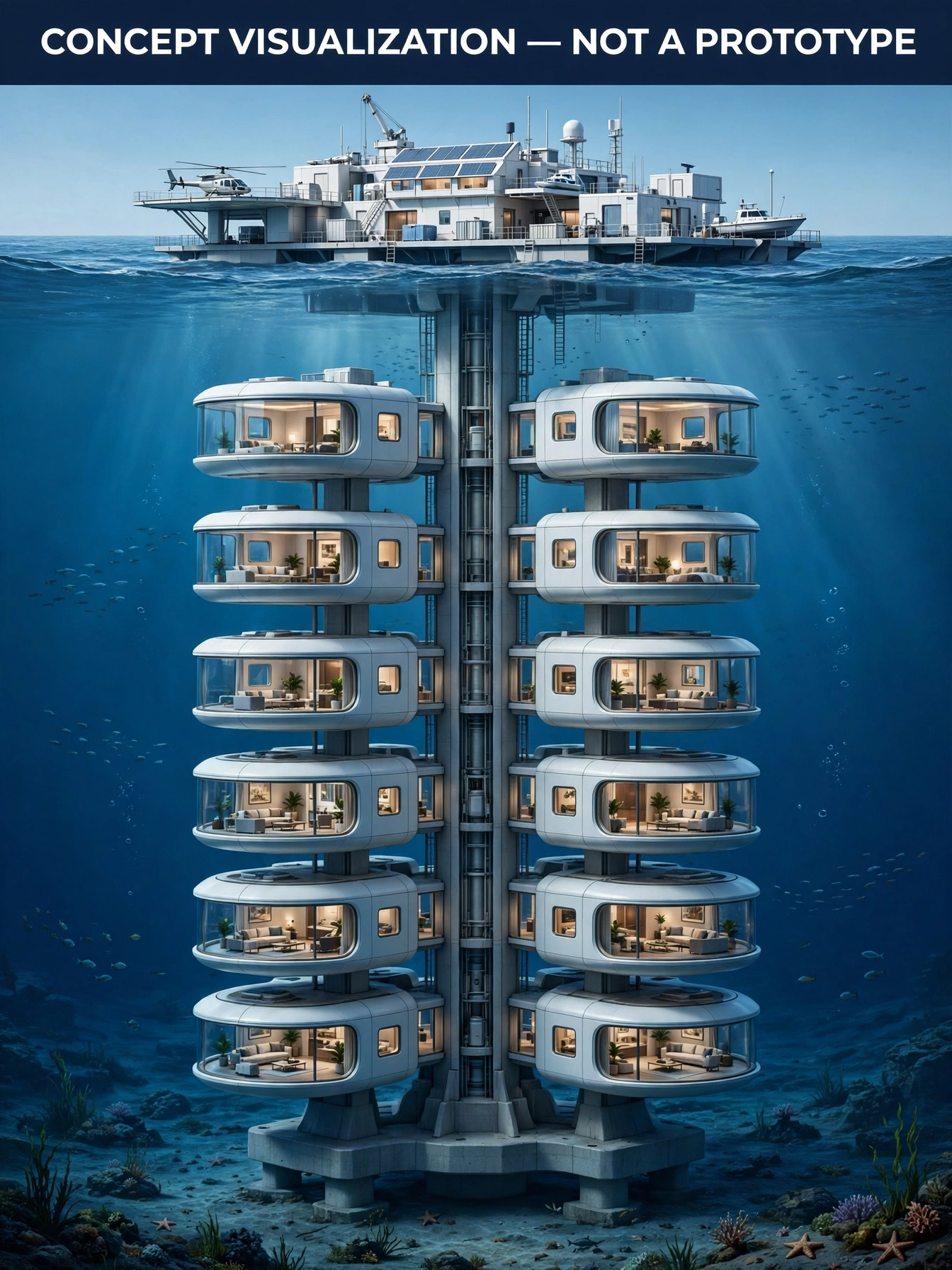
Concept visualization - not a prototype.
What it is
Project AOS is a modular subsea habitat for 120 residents in 20 two-story pods, sited on the seabed with a topside platform for dry access. The engineering baseline is frozen, and Stage 0 is now underway: site selection, third-party verification, and physical prototyping of the power and life-support subsystems.
The offshore industry is entering a decommissioning wave: thousands of platforms are reaching the end of their productive lives, and the industry's subsea capability needs a commercial future. Project AOS answers that with a habitat designed for scale - modular pods, a dry-access spine, and power drawn from the ocean itself - so that living and working on the seabed becomes a repeatable product instead of a one-off expedition.
The architecture
Modular pods
20 two-story, 6-resident pods on a central spine. Add pods, add residents.
Dry access
A continuous dry shaft connects the pods to the topside platform, so crews and supplies move without submersible transfers.
Power
Hydrokinetic turbines around each pod, supplemented by topside solar and wind. Surplus energy is stored as hydrogen and oxygen in a regenerative loop - and the loop makes the habitat's own breathing oxygen from seawater.
Seabed-sited
The habitat sits on the seabed with a topside platform above. Site selection is underway across a ranked shortlist of candidate locations.
The two-story pod
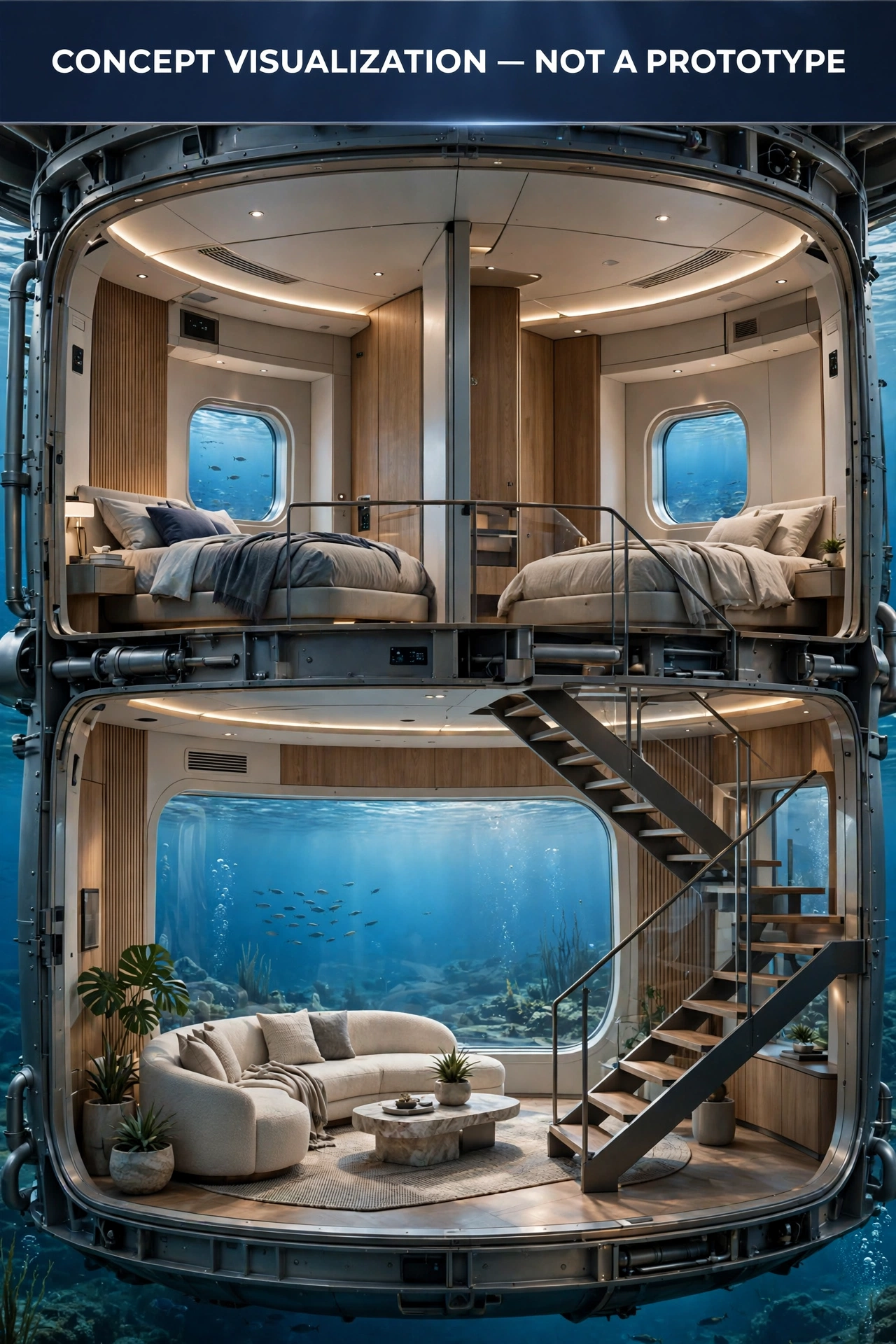
Two-story pod cutaway interior - bedrooms upstairs, living room below - concept visualization, not a prototype.
Where the engineering stands
- Rev. F structural baseline frozen; Rev. G per-pod load budget frozen at 7.25 kW average per pod.
- Power-source design baseline solidified: regenerative PEM loop, distributed per-pod generation and storage, waste-heat recovery for habitat heating.
- Two US provisional patent applications filed August 2026: a hydrokinetic power-generating ocean habitat with a concentric rotating turbine shell (App. No. 64/131,530), and a modular subsea residential habitat system with a central structural spine (App. No. 64/141,100).
- Site selection underway across a ranked shortlist of candidate ocean and lake locations, scored on structural pressure and available current.
- Next steps: site survey and current measurement, third-party FEA, and bench-scale prototyping of the power loop - the work that turns a frozen baseline into a classified, buildable system.
Power and life support
The habitat makes its own power from the ocean around it. Hydrokinetic turbines sit around each pod, so each pod generates where it lives, and topside solar and wind feed the same power bus. The frozen per-pod load budget is 7.25 kW average per pod - 145 kW average across all 20 pods.
Surplus energy is banked as hydrogen and oxygen. A PEM electrolyzer splits purified seawater into oxygen and hydrogen. The oxygen is the breathing gas. The hydrogen is the fuel. When the current slacks, a PEM fuel cell burns the stored hydrogen and oxygen back into electricity. One loop does two jobs: it stores power, and it makes the air the residents breathe.
Seawater is purified by reverse osmosis before electrolysis, because the electrolyzer needs clean water. Carbon dioxide is captured and recycled. Waste heat from the power loop warms the habitat and the hot water, instead of being thrown away.
Each pod makes its own power, stores its own reserve, and shares a DC backbone through the central spine - so a problem in one pod stays a problem in one pod.
What Stage 0 delivers
Stage 0 is the work that turns a frozen baseline into a classified, buildable system. It has four parts:
- Site survey and current measurement - pick the site from the ranked shortlist and measure the current properly, on site, over time.
- Third-party FEA and classification - verify the frozen Rev. F baseline with independent analysis, and follow the classification pathway.
- Bench-scale prototyping of the power loop - prove the electrolyzer and fuel-cell loop on land at bench scale before it goes underwater.
- Systems and operations planning - the full bill of materials, the operating procedures, and the test plan for the first build.
Choosing the site
Site selection is underway across a ranked shortlist of candidate ocean and lake locations. Sites are scored on two things: structural pressure and available current. Shallow, high-current, wave-sheltered water is preferred - it cuts the pressure on the structure and keeps the turbines fed.
The final site choice follows a proper current-measurement campaign on site. No site has been selected yet.
For equity investors
We are seeking equity investment to carry Stage 0 through site survey and current measurement, third-party FEA and classification, and bench-scale prototyping of the power and life-support loop.
What Stage 0 produces is the package a build decision is made from: a verified site, a third-party-checked structure, a proven power loop, and a classified, buildable system.
Investment terms, valuation, and structure are discussed under NDA. Data-room access on request.
Sponsorship
We are seeking sponsors for Stage 0 prototyping: subsystem sponsorship, materials, flume and tow-tank test facilities, and marine operations support.
Sponsors receive recognition, data-room access, and first look at prototype results, under agreement.
Universities - commitment letters
We are seeking university research partners for Stage 0 and federal grant proposals in ocean technology, subsea systems, and marine engineering.
We are asking for commitment letters for grant proposals. No university work begins before funding is secured.
If your group works on subsea systems, marine engineering, ocean technology, or related bench-scale energy systems, we would like to hear from you.
Request access
Detailed engineering, the load budget, and the site shortlist are available under NDA in the Stage 0 data room.
Request an NDAEmail: invest@project-aos.org
Phone: 682-426-1468
Web: project-aos.org